

If you’re already subscribed and/or like the free summary bullets, hitting the LIKE button is one of the best ways to support my research.
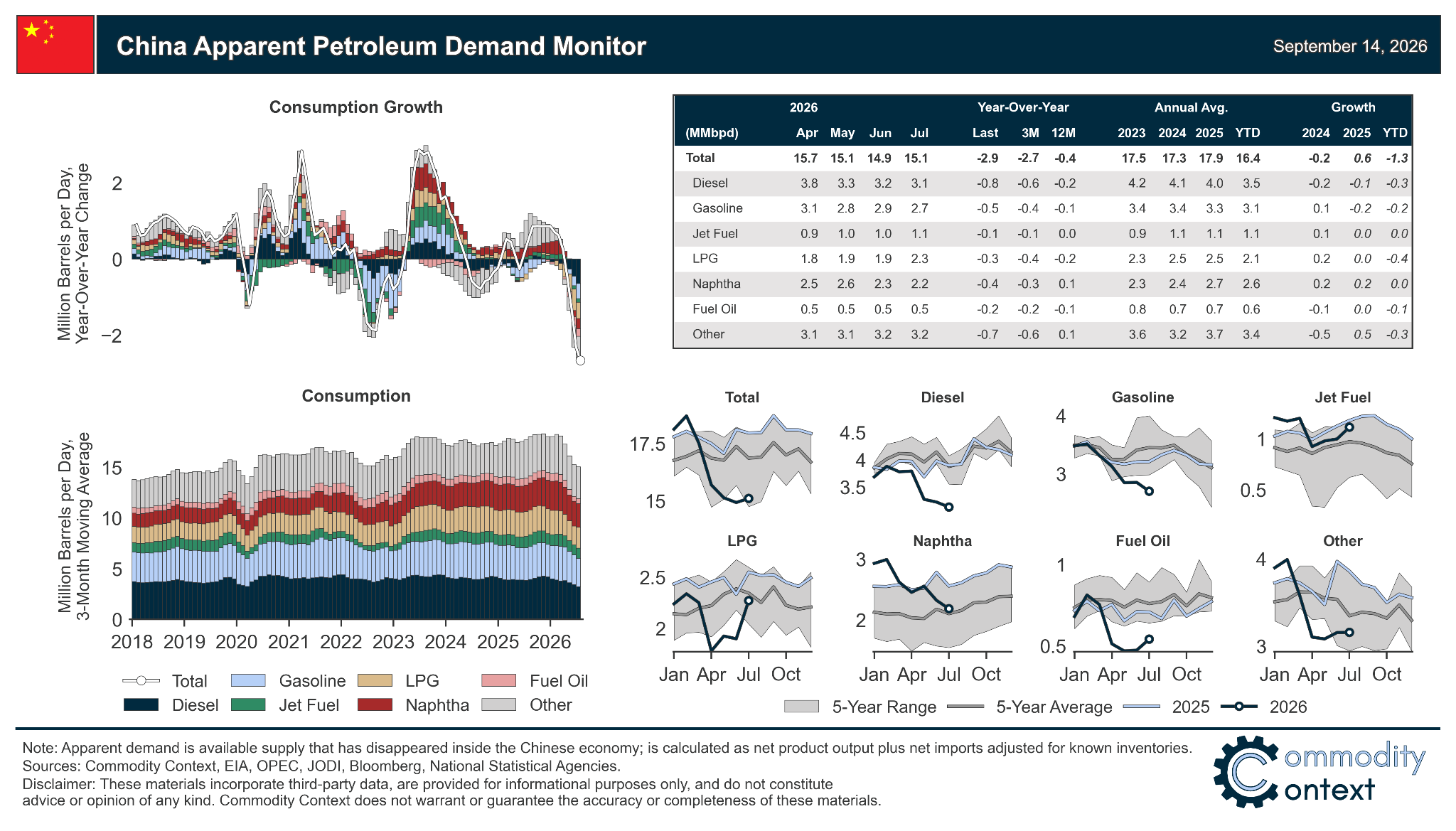
Across virtually all products, the collapse in apparent petroleum product demand—which is to say the available supply / disappearance of product within the Chinese economy—ran far deeper than any commensurate activity decline in end-use sectors.
Export restrictions helped shore up domestic jet fuel and gasoline supplies but China actually saw larger cuts to naphtha and LPG imports; while helping mitigate some product-level imbalances, trade in refined products was actually a net exacerbating factor to the apparent demand shortfall.
The most explainable apparent demand shortfall is jet fuel: a prioritization of refinery yields and the largest pullback in net exports kept domestic markets comparatively well supplied plus a flight-cancellation-driven dip in air travel activity, which collectively explains most—but not all—of the contraction.
Diesel is the largest product category and the hardest to explain: freight activity accounts for nearly 70% of end use yet freight activity continued at a healthy clip despite the near 20% contraction in apparent diesel demand.
World-leading electrification and the penetration of other non-oil-based fuels (e.g., natural gas) help explain China’s resilience to the sudden halt to nearly a fifth of gasoline supply but gradually evolving vehicle fleet composition fails to effectively explain the sudden sharp collapse in apparent fuel demand.
Unobserved inventory management (strategic or otherwise) is a useful explanation in the case of several products—especially diesel and gasoline—where it is difficult to otherwise square the loss of refined product with lack of economic impacts.
It also matters because if inventory management was a key pillar of the Beijing Swing then the Swing is inherently temporary; indeed, we are already beginning to see China crude and other petroleum imports partially recover.
As discussed in Part 1: Crude Oil, China’s colossal crude oil import cut (i.e., “The Beijing Swing”) was the single-largest, and unexpected, counterbalance to the unprecedented shuttering of the Strait of Hormuz. China cut crude seaborne oil imports by a staggering 5.4 MMbpd, a historic exercise of influence over the oil market nearly equivalent to the collective volume of cuts OPEC+ maintained between 2023-24—but by a single country. This historic pullback in apparent crude demand was accomplished through (1) shifts in Chinese strategic crude stockpiling policy and (2) refining run cuts.
Indeed, the lion’s share of the Beijing Swing came from the sharpest pullback in refining runs in China’s modern history, exceeding even the prior record set through Beijing’s COVID-zero lockdowns in 2022. Refining runs fell by at least 2.7 MMbpd from the immediate prewar average pace of 15.2 MMbpd in January-February to roughly 12.5 MMbpd in June, according to official data. Refining run cuts were driven, in part, by the collapse of refining margins to all-time lows. In the face of skyrocketing global open market prices, Beijing’s system of regulated retail prices kept prices at China’s pumps artificially low and relatively stable; but, Chinese refineries were pushed into a situation of losing money on each and every barrel processed.
These significant refining run cuts spurred downstream mystery: how is China managing with such a sharply lower volume of refined fuels coursing through its economy? There are numerous theories about how China pulled off the Beijing Swing without material changes in end-use sector activity. Some of the shortfall was covered by refined product export cuts, which preserved products for the domestic market and stopped the pricing gap from spurring an export boom. Other theories pointed toward coal-to-chemicals feedstock substitution or China’s electrified transportation boom as direct offsets for missing imports, and even broader economic weakness driven by a flagging property sector.
While many coping mechanisms can be identified on a product-by-product basis, it is difficult to ignore overarching signs of “smoothing”. Even combined, these coping mechanisms—from export bans to electrification to precursor production cuts—fail to fully explain the magnitude or pace of the largest-ever rout in Chinese refining runs and domestic fuel supply. Thus, unobserved inventory management (strategic or otherwise) is a useful explanation in the case of several products, especially diesel and gasoline, where it is difficult to otherwise square the loss of refined product with lack of mobility or end-use activity impacts.
The question of whether the Beijing Swing relied on unobserved inventory management of both crude and refined product matters a great deal to its durability. If China did not rely on inventory management, then Chinese demand is remarkably elastic, this can be kept up indefinitely, and the days of durable oil price spike risks are behind us. But if the Beijing Swing was indeed facilitated by some degree of inventory management, then the Beijing Swing is inherently time bound, like any other release of strategic reserves, and has only postponed the inevitable.
This piece, Part 2, will focus on the labyrinth of refined products, natural gas liquids, and petrochemicals to better understand what we know about how China managed the Beijing Swing.
Note: In the process of writing this report, our China oil modelling has been extensively revised to reflect a broader range of more accurate information. We plan to begin publishing these China data soon in a new monthly China Data Deck—stay tuned!