If you’re already subscribed and/or like the free summary bullets, hitting the LIKE button is one of the best ways to support my research.
Summary
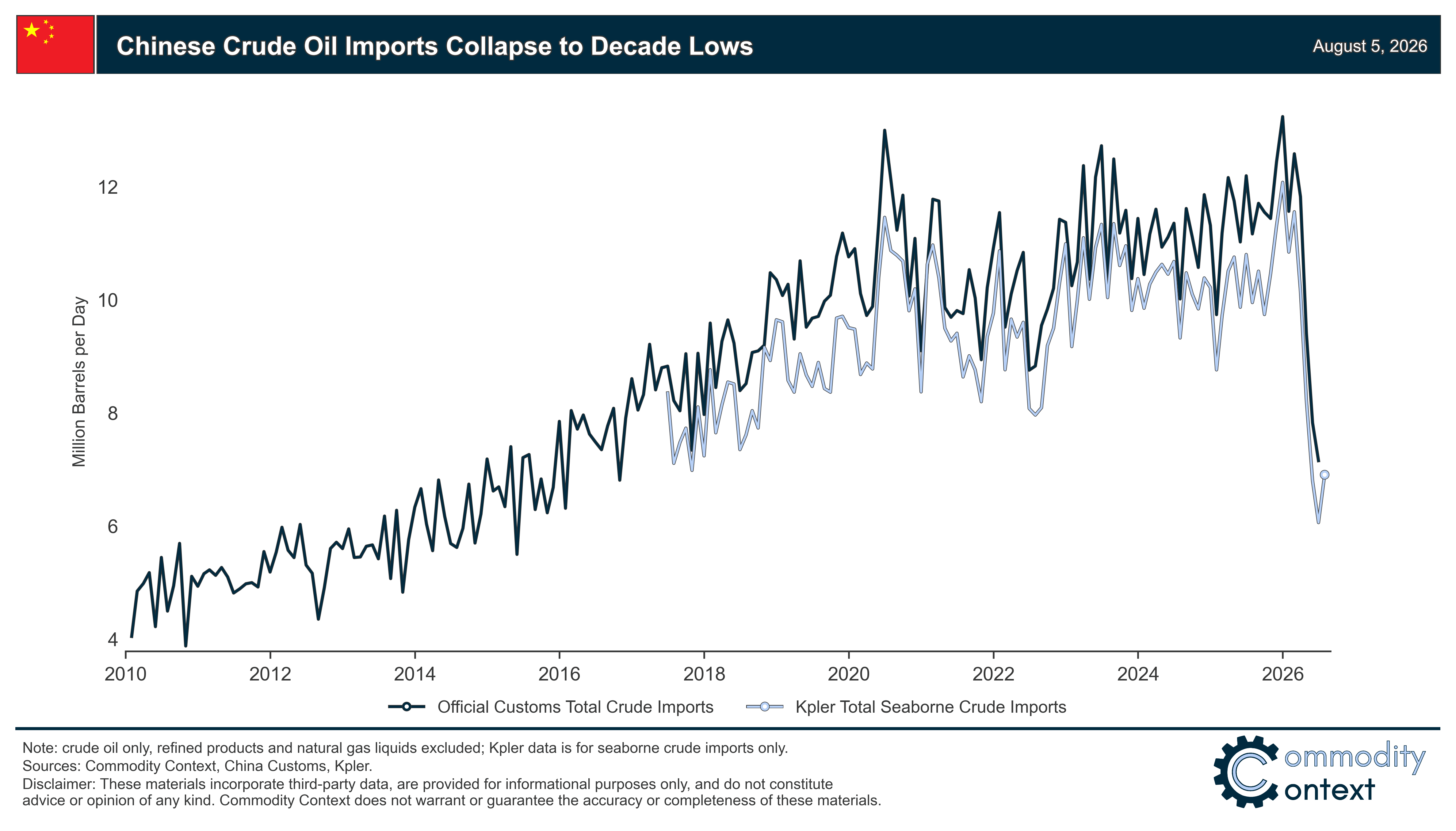
China cut crude seaborne oil imports by a staggering 5.4 MMbpd to blunt the lion’s share of the unmitigated loss of oil supply stemming from the closure of the Strait of Hormuz—what I’m calling the “Beijing Swing”.
This historic exercise of influence over the oil market is nearly equivalent to the total volume of OPEC+ cuts between 2023-24 but was accomplished by a single country in the span of a month or two—far faster than OPEC+’s fractious politics allows.
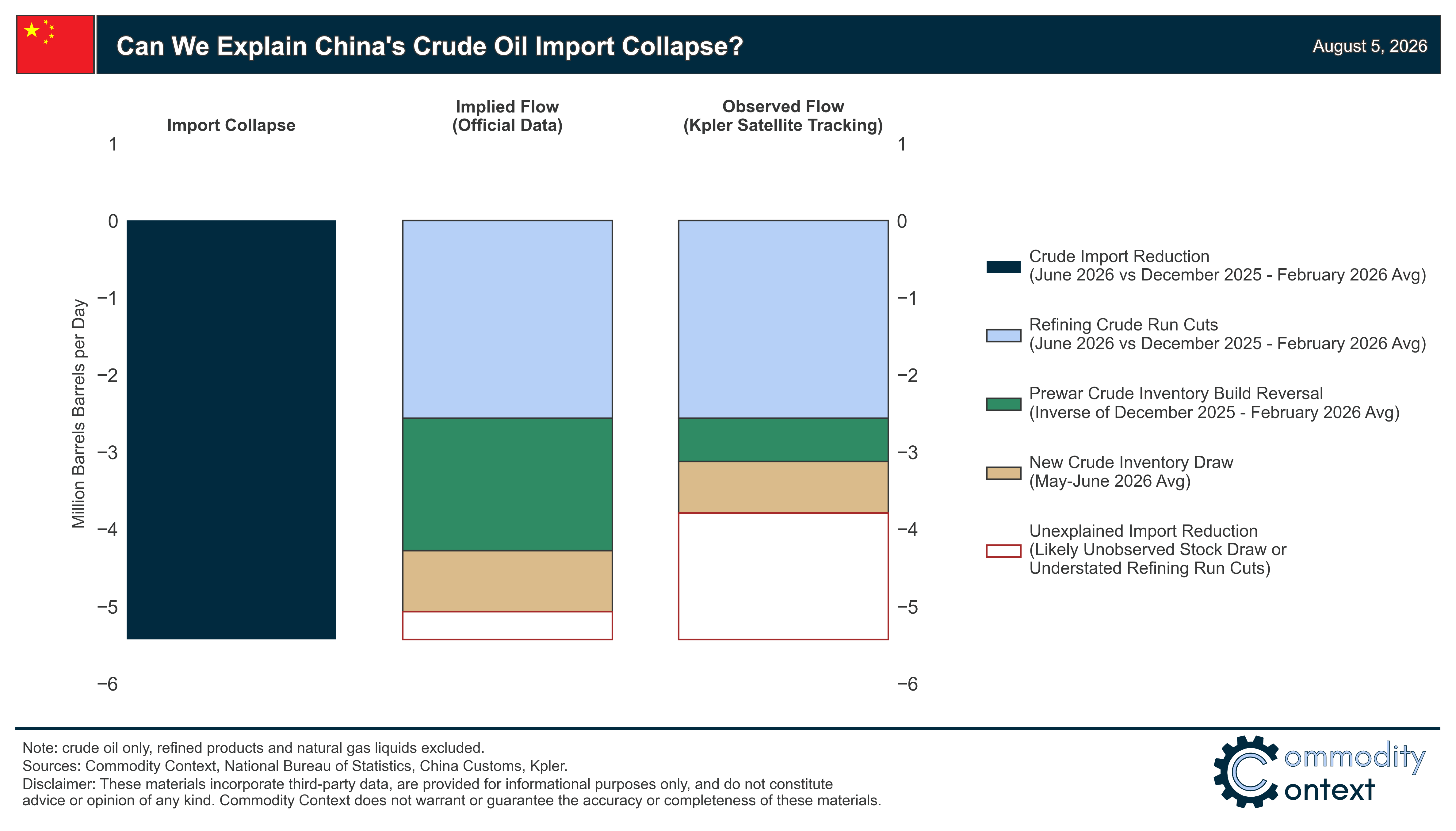
This Chinese crude import collapse was accomplished through a combination of refining run cuts and shifts in Chinese strategic crude stocking policy, though the former spurs further downstream mystery and the exact nature of the latter is now fiercely debated given conflicting data.
The crux of that stockbuilding debate comes down to whether, as implied by official data, the bulk of the inventory swing was driven by a halt to a previously-exuberant pace of builds—the implication being that China doesn’t need to replace these “excess” imports anytime soon—whereas observational (i.e., satellite) data indicates a more modest pace of prewar crude stock building and thus implies a larger role for the release of previously accumulated and unobservable SPR stocks.
In sum, our interpretation acknowledges the reversal of a strong prewar strategic stock building pace (though not nearly as strong as official data imply) as well as the active drawdown of SPR stocks, together with the historic collapse in Chinese refining runs. In Part 2, we will return to the still-mysterious downstream implications of that refinery contraction.
The Beijing Swing has been the most important structural revelation of the Strait of Hormuz crisis. OPEC may be the long-time swing producer of the global oil industry but the Hormuz crisis has highlighted the role of a key swing buyer: China. While OPEC has, traditionally, been the one to cut production in the face of oversupply and hike production in the face of a supply shock, virtually all of OPEC+’s spare capacity was on the wrong side of the Strait of Hormuz. The Iran War largely neutered OPEC’s capacity to offset the historic supply crisis triggered by the closure of the Strait. Meanwhile, China has demonstrated an unexpectedly colossal and unparalleled capacity to throttle global crude oil demand following the start of the Iran War.
Specifically, China cut seaborne crude oil imports by a staggering 5.4 MMbpd from pre-war levels through June, blunting the lion’s share of the unmitigated loss of oil supply stemming from the closure of the Strait of Hormuz. “On the demand side, China has played an important role in stabilising markets by reducing its crude oil imports by nearly 50% compared with pre-war levels,” wrote the International Energy Agency’s Executive Director in mid-July. This allowed the rest of Asia to recover import levels far more easily in the absence of Chinese competition and helped stave off anticipated domestic shortages.
Yet, there is still considerable uncertainty as to both how and why Beijing pulled off this unprecedented import strike. In particular, the question is whether this was an unexpected but natural reaction of China’s economy or an explicit policy choice—and, if the latter, why? This is the first of a three-part report series that explores the Beijing Swing. This piece will focus on Chinese crude oil balances, a more straightforward market compared to the labyrinth of refined products, natural gas liquids, and petrochemicals, which will be covered in Part 2. In the final part, we’ll assess this question of why, exactly, Beijing decided that saving the global oil market was the best course of action in China’s interests.
Colossal Cut