

Hello, Commodity Context subscribers!
Our latest contribution to the Dispatch Energy newsletter, Is Big Oil ‘Price Gouging’? is reprinted in full below. You can also listen to the story via the recorded voiceover.
Welcome to Dispatch Energy! Oil flows are lurching toward recovery in the Strait of Hormuz, and crude oil markets have softened from their historic rally. But you may not have even noticed this near-total return of crude prices to prewar levels if you filled up your family’s car over the holiday weekend. For crude oil, market indicators are signaling at least short-term oversupply, given a rush of long-stranded tankers exiting the Strait of Hormuz and still-weak Asian import demand amid China’s ongoing buyers’ strike. Indeed, West Texas Intermediate (WTI) crude prices are back below $70 a barrel, even amid continued instability in the Middle East.
Despite WTI crude prices being roughly the same as last summer, current consumer prices are materially higher. Average U.S. gasoline prices are sitting around $3.80 per gallon—down from more than $4.50 in May but still considerably higher than February’s less than $3.00 and last summer’s average of $3.15. U.S. diesel prices are even more elevated at $4.80 per gallon, down from $5.70 in May but more than $1 higher than the same time last year.
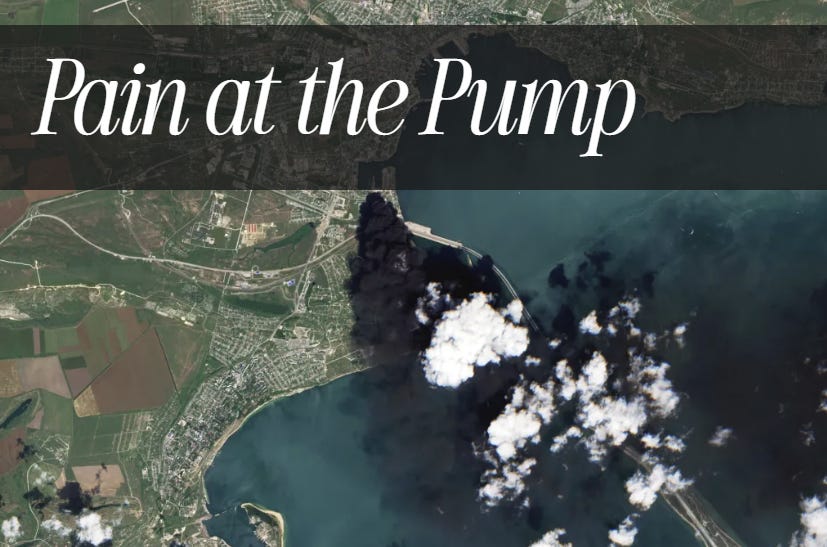
Satellite view of burning storage tanks and heavy smoke following attacks on the Kerch fuel terminal on June 21, 2026. (Photo by Gallo Images/Orbital Horizon/Copernicus Sentinel Data 2026)
Elevated gas and diesel prices have frustrated President Donald Trump, who in a series of Truth Social posts accused “big oil companies” of keeping gas prices high in order to “gouge” American consumers. “DROP YOUR PRICE FOR OUR GREAT AMERICAN PEOPLE,” he wrote in one post, citing $2.50 per gallon as his desired price. Treasury Secretary Scott Bessent followed up these presidential appeals with his own call for companies to lower prices ahead of the country’s 250th July 4 celebration last week, ominously saying “we’re watching.”
Meanwhile, the American Fuel and Petrochemical Manufacturers published a brief explainer about what these fuel margins mean and don’t mean. It’s clear that the group, representing the U.S. refining and petrochemical industry, is sensitive to the mounting rhetoric from the Trump administration.
The challenge for the Trump administration is that, while certainly related, crude oil and its refined products (gasoline, diesel, jet fuel, etc.) are all distinct commodities. Each has its own balance of supply and demand: The supply of refined products isn’t driven by how much crude oil is pumped out of wells in the southwestern United States’ Permian Basin—or even released after four months stranded in the Persian Gulf. Instead, the supply of refined products depends on how much of that crude oil is processed each day in the world’s more than 500 oil refineries.
Therein lies the problem: Global refinery capacity is currently struggling to keep up with demand for petroleum products. Let’s say that we have 100 units of crude and 100 units of refined product demand but only enough refinery capacity to process 80 units of crude into 80 units of refined product. This is the reality of the oil market today: There is too much crude, which is crushing crude oil prices, and not enough refined products, which is spiking consumer prices.
This difference—between the price of crude and the price of refined product—is known as the “crack spread.” It’s called this because, very simply, a refinery is a giant chemistry set that “cracks” the dense hydrocarbons in crude oil into various lower-density products, like gasoline and jet fuel. Unlike our simplified model above, a refinery can’t transform a single barrel of crude oil into an equivalent volume of gasoline; instead, it produces fractions of a barrel of the entire rainbow of refined products—from the heaviest materials (e.g., asphalt) to middle distillates (e.g., diesel) to the lightest elements (e.g., propane).
The price of a barrel of Brent crude oil currently sits around $75, whereas a barrel of U.S. gasoline is fetching $125 (a $50 per barrel crack spread, compared to a seasonal norm nearer $20) and a barrel of diesel is going for more than $140 (a $65 per barrel crack spread, compared to a seasonal norm nearer $20). The crack spread is the primary driver of refinery profitability, and, for multiple reasons, refined product markets are currently much tighter than crude markets.
Let’s start with the direct impacts of the closure of the Strait of Hormuz. The prewar flow of some 20 million barrels daily through the Strait of Hormuz consisted of roughly 15 million barrels of crude oil and 5 million barrels of refined products. While offsetting pipelines in Saudi Arabia (to the Red Sea) and the United Arab Emirates played a critical role during the Hormuz crisis, these pipelines carried only crude oil, not refined products. The same goes for the release of strategic petroleum reserves: Virtually all of this volume was crude oil rather than diesel or gasoline.
Then there are the broader impacts of the Iran war and, specifically, China’s abrupt cut of nearly half its prewar crude oil imports, dropping roughly 5 million barrels per day from February. On one hand, this was the single largest unexpected factor that helped defuse the worst of the oil market crisis by massively reducing crude oil demand and loosening historically tight seaborne crude markets. On the other hand, it further tightened global refined product markets. Domestic Chinese refining activity cratered and Beijing imposed strict controls on Chinese fuel exports to safeguard domestic supplies through the Hormuz crisis.
These actions also reduced refined fuel exports from the rest of Asia and sent ripple effects through the global industry. As S&P Global explained in an analysis of the supply squeeze, “Octane blending economics have deteriorated as Asian steam crackers curtail operations due to reduced Middle East naphtha exports, tightening global supplies of high-octane blending components, including reformate and aromatics.”
The next reason is Russia’s domestic fuel crisis, the largest since the fall of the Soviet Union, amid relentless Ukrainian drone strikes. Ukraine has targeted Russian energy facilities for years, but there was a renewed surge in attacks through the Iran war as Kyiv attempted to prevent Moscow from profiting off war-related spikes in global pricing. Estimates from Energy Intelligence indicate that nearly one-third of Russia’s total refining capacity, or more than 2 million barrels a day, was offline due to these attacks through June, with domestic refining runs at their lowest point in more than two decades. And the attacks look poised to continue: just this week, Ukrainian drones managed to strike Russia’s largest refinery, located deep in Siberia and roughly 2,700 kilometers from Ukrainian-held territory, knocking it offline.
Without domestic refining capacity, Russian seaborne refined product exports have fallen from nearly 2.5 million barrels a day to less than 1.7 million, according to ship tracking data from Kpler. In addition, Moscow has banned the export of gasoline and jet fuel and is weighing a ban on diesel exports (Note: since publishing, Moscow has confirmed this ban). Russia is one of the world’s largest seaborne suppliers of diesel, so this is another considerable hit to refined product supply.
While Chinese and Russian exports cratered through the Hormuz crisis, U.S. exports surged. Both diesel and jet fuel exports, as well as crude exports, hit record highs in recent months. American refineries maximized jet fuel output to help satiate that particularly starved market. Meanwhile, gasoline’s share of refining yield fell to levels only previously seen during the depths of the COVID pandemic in 2020 and amid the housing market crash of 2008. And we can clearly see this domestic supply tightness in inventory levels. U.S. gasoline stockpiles are at the lowest seasonally adjusted level since 2014, while U.S. diesel stocks have only recently begun to climb back after hitting their lowest seasonally adjusted levels in 30 years.
Finally, there is one additional, U.S.-specific policy factor further stoking domestic refined product prices: the exploding value of renewable identification numbers, aka RINs. Contributing materially to the higher price of U.S. fuel, RIN prices have more than doubled this year due to a sharp increase in the 2026 biofuel blending obligation, especially for biodiesel and renewable diesel. The Environmental Protection Agency sets renewable fuel volume requirements under the Renewable Fuel Standard. Refiners and importers of gasoline or diesel then satisfy those requirements by acquiring and retiring RINs, compliance credits that are generated by blending renewable fuel or buying excess RINs generated elsewhere.
So, it’s a good news, bad news story for the efficacy of the deal that the U.S. and Iran struck to resume shipping in the Strait of Hormuz.
The good news is that shipping traffic through the waterway has recovered more quickly than feared, although the sustainability of the rapid recovery has yet to be determined. This exiting Hormuz surge, combined with the still-weak state of import demand, especially in China, has pushed crude prices back to prewar levels.
The bad news is that Trump clearly expected pump prices to follow crude oil’s rapid pullback just in time for the midterm elections, and so far they have not. The lagged effects of the Hormuz crisis, Ukraine’s success in crippling Russia’s refining sector, and his own administration’s biofuel policies have worked together to keep pump prices stubbornly high.
Disclaimer: These materials incorporate third-party data, are provided for informational purposes only, and do not constitute advice or opinion of any kind. Commodity Context does not warrant or guarantee the accuracy or completeness of these materials.
Thanks for the article, Rory. Is it correct then to say that most of the refining capacity in the Persian Gulf (around 10Mbpd, if I am not mistaken) is shut down, as products cannot get out of the Strait of Hormuz, and the bypass pipelines only carry crude? Then the capacity math would be something like that? 10M (SoH) + 5 (China) + 2 (Russia) = 17.