

Hello, Commodity Context subscribers!
Our latest contribution to the Dispatch Energy newsletter, Donald Trump’s Diesel Desperation, is reprinted in full below. You can also listen to the story via the recorded voiceover.
Note: This piece was originally published on Tuesday, October 20th. Since publication, the White House has also offered to tap the Northeast Heating Oil Reserve and Moscow has said that the first cargo of Russian diesel will soon leave for the US in an obvious political favour. Both these developments will be further discussed in tomorrow’s Oil Context Weekly report but I wanted to flag here given the ongoing tracking of Trump’s diesel desperation.
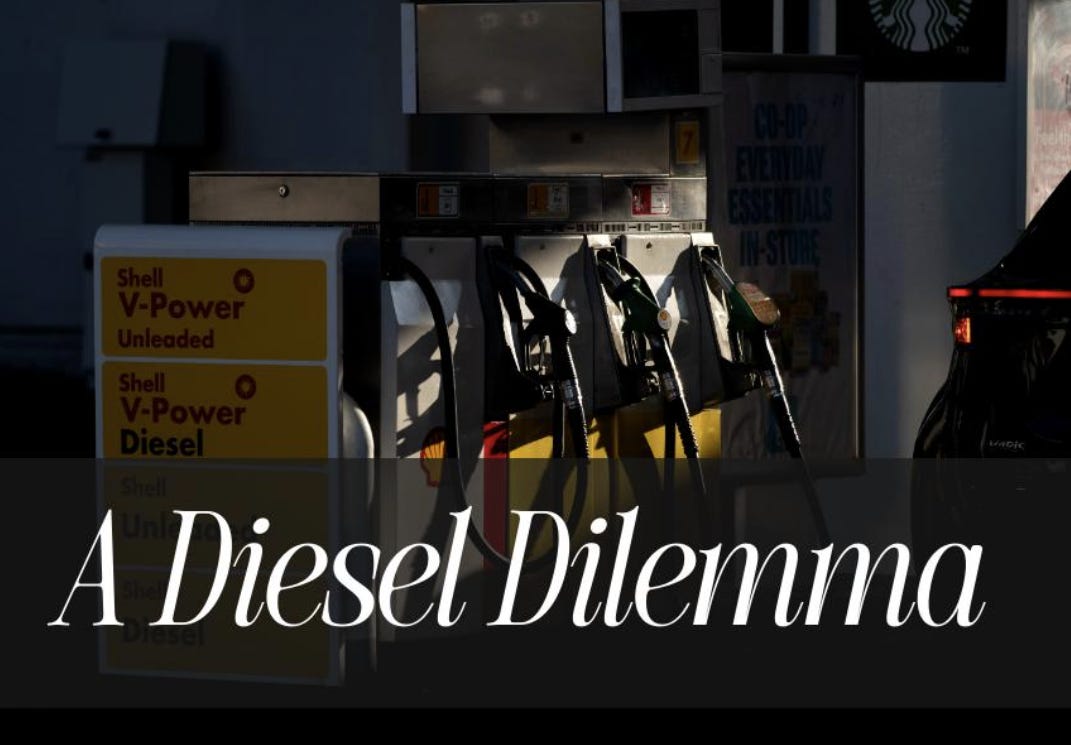
A petrol station in London, United Kingdom. (Photo by Bryn Colton/Getty Images)
Welcome to Dispatch Energy! U.S. wholesale diesel prices are near all-time highs at more than $200 per barrel, while American voters face average retail diesel pump prices above $6 per gallon. With the midterm elections just weeks away, this is a catastrophic electoral reality for incumbent Republicans given the wide body of research confirming the negative relationship between gasoline pump prices and the approval and electoral success of the party in power; there has been less research on diesel, specifically, given that until recently that wasn’t the epicenter of fuel crises. Now, diesel’s importance to farming—and, more importantly, farm states’ importance to the balance of congressional control in 2026—is at the forefront of this midterm election cycle.
It’s therefore unsurprising that the White House is getting increasingly desperate as Election Day draws near. The Trump administration is pulling every available lever to bring those diesel prices down: from threatening export bans and browbeating Europe into releasing emergency stocks to pursuing tax loopholes and, most recently, striking a diesel supply-for-sanctions-relief deal with Russia. But these interventions are rounding errors in the scale of the current crisis. At best, the White House is providing a list of policy interventions for embattled Republican candidates to avoid taking the blame for high pump prices. Let’s review.
A Diesel Dilemma
Let’s first understand our current, historic diesel supply crisis. In total, seaborne exports from the world’s largest suppliers are down between 1 million and 1.5 million barrels per day (bpd) this year, compared with global demand of roughly 30 million bpd. Despite President Donald Trump’s claim that “The World’s Diesel price rise is mostly caused by the Russia/Ukraine War, not Iran,” the Iran war, along with the broader Middle Eastern security crisis, remains the largest driver of the rout in seaborne diesel exports. At the same time, Russia’s invasion of Ukraine and Kyiv’s recent strategy of striking Russian refineries have undoubtedly contributed materially to the diesel supply crunch.
The largest supply loss is in the Middle East, where refined product exports remain below half their prewar levels. The flow of crude oil through the Strait of Hormuz had risen markedly through September but dropped slightly in October on the back of the largest string of shipping attacks thus far. Part of the asymmetric recovery—between refined products and crude oil—stems from the logistical realities of the clandestine crude oil trade; high shipping and insurance costs favor the largest category of tanker, which typically carries crude. More structurally, there is evidence of damage to Middle Eastern Gulf refineries as well as growing losses of Saudi Red Sea refined product exports due to Houthi attacks on Saudi processing facilities.
In addition, Ukrainian attacks on Russia’s refinery fleet have collapsed Russian exports of diesel and gasoil (a related middle distillate product). Ukraine has focused on Russia’s energy sector infrastructure in an effort to bring Moscow’s war back to the Russian homeland, with sophisticated drone and missile attacks hobbling major oil-exporting ports, fuel depots, tankers, and, most importantly, oil refineries. Russia is normally the world’s second-largest exporter of diesel and gasoil, but those exports have been throttled from just under 1 million bpd to a trickle of barely over one-tenth of that flow today.
A Russian domestic supply crisis has dragged on foreign shipments. The collapse of Russia’s domestic fuel supply has sparked domestic shortages and long gas lines reminiscent of the U.S. experience through the oil shocks of the 1970s (or, closer to home, Soviet-era lines for almost everything). Moscow moved to ban the international sale of gasoline, jet fuel, and, finally, diesel, closing the export door almost entirely (although a very small volume of exports continued despite the announced ban).
Trump has wrongly attempted to shift most of the blame for high diesel prices onto Ukraine’s refinery strategy. On the other hand, Ukraine’s defenders similarly overstate their case when they argue that the refinery attacks have had no effect on global fuel prices—the loss of substantial volumes of Russian diesel supply has undoubtedly further tightened the market for the industrial fuel.
More broadly, diesel demand has proved stickier and harder to destroy than gasoline consumption. Prices have been pushed to record levels: New York Harbor diesel futures prices hit an all-time high of nearly $230 per barrel in September—more than twice the value of a barrel of crude. As a result, diesel’s so-called crack spread (i.e., the difference between crude and refined product prices) has risen to record levels; it currently sits around $100 per barrel, roughly five times its normal level of around $20 per barrel. It is in this context that the Trump administration is now frantically searching for any measure that will alleviate diesel prices, even temporarily, ahead of the midterms.
Russian respite.
We’ll start with the most recent deal between Washington and Moscow. Following a phone call with the Kremlin in early October, Trump announced that Russian President Vladimir Putin pledged additional supplies (e.g., 500,000 tons of diesel in November) to help alleviate the ongoing diesel crisis. To ease the flow of these Russian barrels into the strained global diesel market, the U.S. Treasury waived U.S. sanctions on Russian diesel through April 7, 2027.
The challenge with this intervention is that the volumes at play (500,000 tons in November) sound large but only represent roughly 125,000 bpd of export flow. And it’s not entirely clear whether the pledged volumes are target levels or truly additional barrels; current Russian exports of diesel and gasoil stand between 100,000 and 150,000 bpd, so Putin’s 125,000 bpd pledge is either a commitment to the beleaguered status quo or, in the best-case scenario, a doubling of those shipments from one-tenth of the prewar norm to more like one-fifth. Even without any changes to the status of Russia’s refinery fleet, we would expect Russian exports to rise modestly over the coming months as domestic demand declines following the harvest season.
Moreover, Moscow isn’t voluntarily restricting diesel exports. For Russia to materially lift its diesel exports, Ukraine would need to stop bombing Russian refineries. To that end, Trump tried to announce an “energy ceasefire” between Moscow and Kyiv on October 11. Ukrainian President Volodymyr Zelensky initially agreed to honor a ceasefire if Moscow halted strikes on Ukrainian energy infrastructure ahead of winter. But Moscow hit numerous Ukrainian energy assets like power generation stations later that day, and Zelensky noted that these attacks were evidence that Putin was “unwilling to accept an energy ceasefire.” A White House official later told Axios that it wasn’t really so much an “energy truce,” per se, as a “refinery for refinery proposal.”
All else equal, Trump’s sanctions relief for Russian diesel actually further bolsters Kyiv’s rationale for striking Russian refineries: A big driver of the strategy was Ukraine’s desire to deprive Moscow of windfall energy earnings on the back of the Iran war. Indeed, the temporary lull in Ukrainian strikes against Russian refineries ended Thursday with an attack on a refinery in the Ryazan region southeast of Moscow. Zelensky told the Financial Times that he has run out of patience with Trump’s diplomatic theater and that “we’re done.” Ukrainian forces have struck numerous other refineries and fuel facilities over the past week.
Coercing Europe.
Trump has also openly toyed with the idea of banning U.S. diesel exports to preserve domestic supplies. Republican lawmakers from farm states have called on the administration to restrict U.S. diesel exports, with Iowa Sen. Chuck Grassley declaring that “High diesel prices ARE KILLING FARMERS INCOME.” Trump in September confirmed that his team was “seriously considering” such a ban but later abruptly abandoned and rebranded the idea as merely a threat to force European countries to release their emergency diesel stockpiles. To his credit, Energy Secretary Chris Wright came out strongly against the idea, arguing, “The blunt tool of banning diesel exports definitely doesn’t work.” Wright is right, and thankfully the administration has generally dropped the idea.
Banning U.S. diesel exports was never a real domestic policy solution. The U.S. Gulf Coast refining hub is a structural net exporter of diesel because the region produces more than it can consume. If those exports had suddenly been blocked by presidential trade restrictions, inventories would have begun to rapidly build and local prices would have begun to fall. The challenge is that, while consumer prices would have fallen in the short term (i.e., ahead of the polls), lower prices would, after a few weeks, have destroyed the incentive for refineries to run so aggressively. U.S. refinery utilization currently sits around 94 percent, well above the norm, precisely because prices are so high. So, even though a diesel export ban would have been popular with Trump’s political base, this policy intervention would have ultimately had a negative impact on domestic supplies of diesel, as well as gasoline, jet fuel, etc.
Such a ban would have also dealt a crushing blow to the already fragile global diesel market. While the Middle Eastern and Russian diesel exports have collapsed this year, U.S. exports have risen notably to fill the gap. Initially, Trump even boasted about this export boom as a sign of the U.S.’s energy dominance. Indeed, the loss of U.S. diesel supplies would acutely spike global prices. This move would further harm allied economies and feed inflationary pressures that would, in turn, be imported back into the U.S. via the East and West coasts, which remain structural importers of fuel.
So the White House pivoted to using the threat of a ban to coerce European countries into agreeing in early October to release emergency diesel stockpiles. While the specific pledges are still unclear, an earlier French proposal included 50 million barrels of both crude and diesel, and later G7 language indicated that pledged volumes would be released over four months. This is not a solution, but it is a meaningful salve through what is widely expected to be an excruciatingly tight winter heating oil season. A 50-million-barrel emergency diesel release over four months would offer real, albeit temporary, relief—roughly one-third of our recent loss of supply between the Middle East and Russia. The official G7 communiqué included a pledge for a “frontloaded substantial diesel release within the first 20 days,” though, crucially, it has been 18 days since the announcement and there are no tangible results.
Neither side is exactly innocent here: It is obviously wrong to threaten allies with a ban on critical exports during a fuel crisis, but European countries would have a far stronger case if they hadn’t slow-played their contributions to the record 400-million-barrel International Energy Agency (IEA) release announced in March. The IEA noted this month that roughly 100 million barrels of the 400 million barrels pledged have yet to be released. European industry insiders have argued that European emergency stocks are held back in case of actual supply shortages and not just to drive down prices. But the entire purpose of the March release was to offset the acute loss of Middle Eastern supply to blunt economically debilitating price spikes. And both the U.S. and Japan have largely fulfilled their crude-heavy commitments.
Red dyeing and other efforts.
In early October, Trump issued an executive order that “temporarily opens highway use of tax-free dyed diesel, deferring the federal diesel tax on that fuel through the end of the year” to “immediately cut diesel costs for the truckers and farmers who keep America moving.” Red-dyed diesel is chemically identical to normal diesel except for the addition of red dye that both indicates its tax-free status for off-road uses, including in farm equipment, as well as allows tax authorities to enforce that off-road use—a driver risks steep fines if their on-road truck is inspected and found to have red dye inside the engine.
The decision to suspend enforcement of these restrictions shows that efforts to ease fuel costs have clearly extended beyond geopolitics and into areas of tax policy that the White House can adjust without new laws from Congress. However, the operative word here is deferred rather than eliminated, leaving future tax liabilities and enforcement uncertain. And more importantly, this policy intervention doesn’t do anything to actually change the available supply of diesel across the U.S. economy.
Instead, the policy intervention is, most realistically, a distraction that farm-state candidates can point to in their stump speeches. At best, it’s a back door to fuel tax relief without a congressional vote; at worst, it could add further uncertainty for those already attempting to navigate the ongoing fuel crisis. In my conversations, congressional staffers from farm states even cited farmers’ concerns that this could boost nonfarm demand, making it harder for farmers to source fuel.
In conclusion.
The White House is trying everything within its power to alleviate record diesel prices ahead of the midterm elections but has, overall, failed to move the needle. The White House remains dependent on Europeans, who have chronically slow-played their reserve-release commitments, to act quickly; Ukrainian forces to pull back from their most successful strategy against Moscow to date; and, more generally, U.S. midterm voters to accept these policy intervention efforts. In the long run, U.S. consumers will only experience lasting relief at the pumps when the wars in the Middle East and Ukraine end.
Disclaimer: These materials incorporate third-party data, are provided for informational purposes only, and do not constitute advice or opinion of any kind. Commodity Context does not warrant or guarantee the accuracy or completeness of these materials.