

Happy weekend, Commodity Context subscribers!
As I have previously mentioned, we have joined a rotating roster of energy sector specialists who will be contributing to the weekly Dispatch Energy newsletter, which is entirely free to read thanks to a sponsor so you should subscribe!
The goal will be to share some of the themes we regularly write about here at Commodity Context but at a higher level and for a broader audience. We will also be sharing those write-ups here for our regular subscribers. The main story from our fourth contribution, Can Trump Take Credit for Lower Oil Prices?, is reprinted in full below. You can also listen to the story via the recorded voiceover.
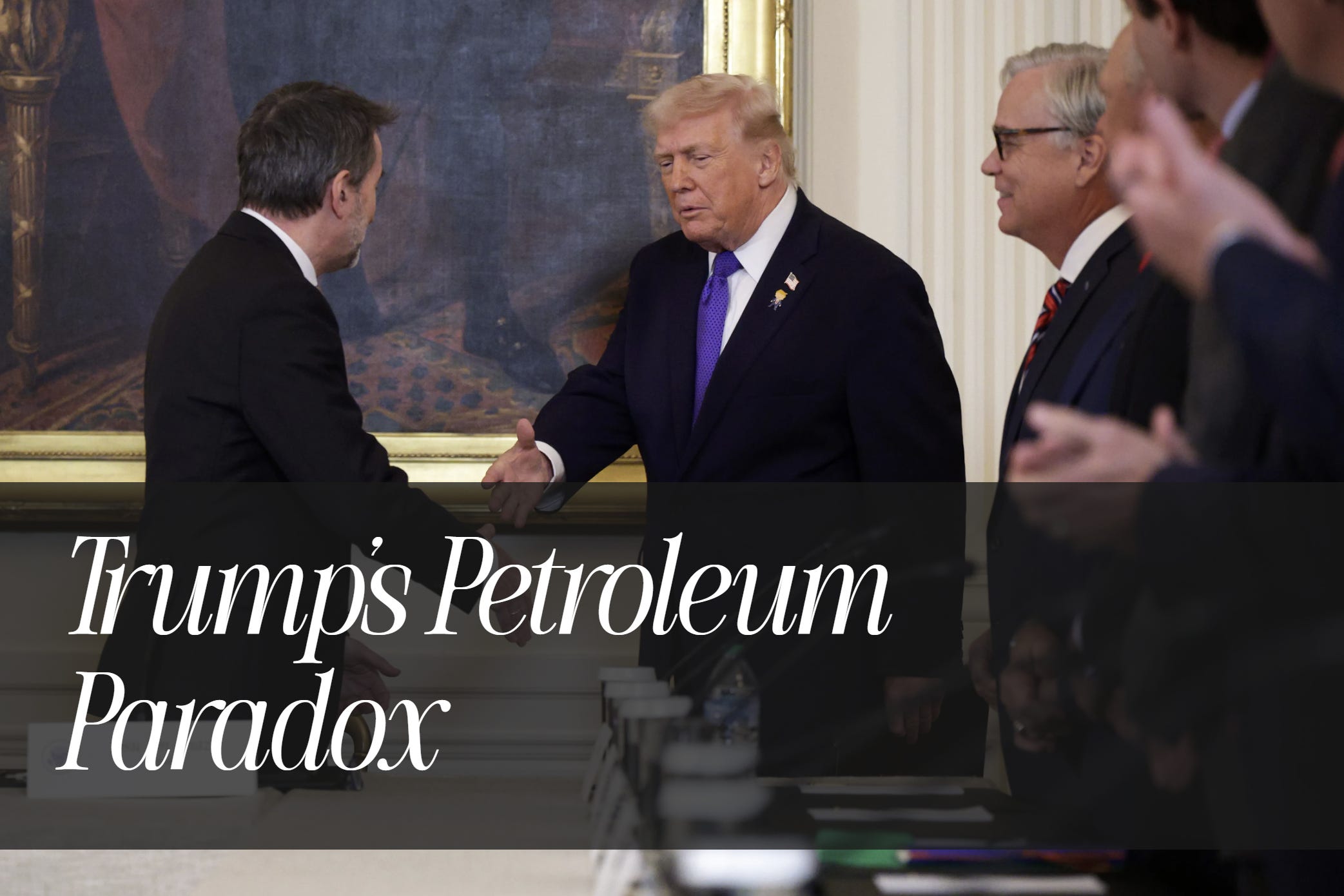
President Donald Trump arrives at a meeting with oil and gas executives in the White House on January 9, 2026. (Photo by Alex Wong/Getty Images)
Welcome to Dispatch Energy! Whether he’s actively complaining when prices are high or treating low(er) prices as a benchmark of personal success, it’s fair to say President Donald Trump is oil-obsessed. This fixation isn’t particularly novel; U.S. presidents have been preoccupied with oil prices for more than half a century, and a large body of research shows that presidential approval rates are negatively correlated with prices at the pump.
Speaking to the New York Economic Club during his 2024 campaign, Trump touted a plan to “cut energy prices in half or more than that within 12 months of taking office.” He went on to tie lowering oil prices to his broader geopolitical goals: “I mean, nothing’s easy in life, but Putin, at $100 a barrel, war works. At $40 a barrel, it didn’t work at all.” And indeed, since Trump’s return to office in January 2025, the price of a barrel of Brent crude oil fell from roughly $80 to a recent low of less than $60 in mid-December, and average U.S. gasoline pump prices have fallen from around $3.10 per gallon to $2.90 per gallon.
Not so fast. While it is undeniable that President Trump wants lower oil prices, his track record—in terms of oil market influence through his first year back in office—is mixed, and arguably leans in the opposite direction. Thus far in his second term, Trump has been a net positive factor—i.e., bullish—for oil prices, tightening the market through his aggressive policies toward producers Iran, Russia, and Venezuela. That prices have dropped, then, is largely in spite of the White House and has been the result of policy choices by the world’s other major oil-producing states. Let’s break it down.
Avenues of influence.
While the influence of American presidents over the global price of crude is often overstated, that’s not to say that the holder of the most powerful office in the world has no power at the pump. For example, after Russia’s invasion of Ukraine led to all-time-high U.S. gas prices, President Joe Biden embarked on the massive, record-setting release of more than 200 million barrels of crude oil from the U.S. Strategic Petroleum Reserve—a move that surely contributed to lower prices.
In contrast, most of President Trump’s direct interventions in the oil market have had quite the opposite effect. Largely due to his imposition and stricter enforcement of sanctions against major crude exporters (e.g., Iran, Russia, and Venezuela), Trump has been a bullish factor for oil prices. As I explored in a previous edition of Dispatch Energy, the oil market is in structural oversupply following a decision by OPEC+—a group of oil-rich nations that controls crude output equivalent to around 40 percent of global oil production—to rapidly increase crude output last year. But it certainly doesn’t feel like it’s digesting a historic supply glut, which under normal circumstances would result in plummeting prices. With Brent crude prices bouncing around $65 even before the latest Iran-risk rally, there’s been a clear disconnect between the volume of oil supply on the market and the barrels driving end prices. This contradiction is, in large part, because of Trump’s sanctions agenda, which has targeted not just oil exporters but also their intermediaries and buyers. The result is that more and more sanctioned barrels are having a harder and harder time making their way to market, with journeys to buyers less wary of sanctions— namely China—taking longer and involving more frequent logistical delays.
Has Trump lowered oil prices?
Despite vowing to slash energy costs for American buyers, it’s difficult to prove Trump’s hand in the main driver of lower prices: OPEC’s decision to increase production. Some onlookers argued that, in the lead-up to the 2024 election, OPEC+ had kept production low—and, thus, prices high—out of a political preference for Trump over Biden or Vice President Kamala Harris. And Trump did actively urge OPEC to increase production to tamp down prices. There’s even been speculation that Trump may have privately struck an explicit deal with OPEC+ leadership, exchanging broad political favor for more oil production.
This claim is both difficult to prove or disprove, but there’s reason for skepticism. OPEC+ had ample reason to begin hiking production in 2025 regardless of who was in the White House: The producer group was backed into a corner after nearly three years of ever-deeper production cuts in an ultimately unsuccessful attempt to maintain stronger crude prices. The situation was further exacerbated by worsening compliance among core OPEC+ members, fully and publicly unraveling after Kazakhstan blew past its production quotas as a major new project came online. Still, it’s also impossible to rule out the idea that Trump’s more transactional approach to diplomacy—not to mention his personal and business connections to many OPEC+ member states—improved his odds of increased production.
But that’s where Trump’s bearish influence on oil prices begins and ends. It was presumed, when he took office, that the Trump administration would slash regulatory burdens on U.S. producers, thereby allowing them to “Drill, Baby, Drill.” Looser regulations would reduce the break-even price for the U.S. shale patch and result in more production at that lower price point—a double win for American voters. In reality, however, U.S. oilfield activity collapsed alongside the price of oil. The double whammy of Trump’s Liberation Day tariffs announcement and OPEC+’s decision to triple the pace of monthly production hikes stressed the sector. The number of oil-directed drilling rigs operating in the U.S. dropped nearly 20 percent year-over-year, and the U.S. Energy Information Administration downgraded its forecast for the U.S. crude oil production outlook, which is now expected to contract in 2026 and 2027 for the first time since 2020.
Still, some analysts argue that the tariffs helped lower retail prices for American motorists, given the theory that the downward pressure they put on global economic growth would, in theory, weaken demand growth. This is, at best, a simplification. In reality, petroleum product demand growth strengthened in 2025, following the announcement of tariffs, compared to more anemic consumption growth in 2024.
Or has Trump increased oil prices?
Rather than lower the price of crude, Trump’s policy choices continue to prompt acute oil market rallies. The price of a barrel of Brent crude is back above $70/bbl today despite the backdrop of acute oversupply discussed above, with the administration’s agenda largely bridging the disconnect between the current prices and slower-moving underlying fundamentals. Trump has consistently ramped up economic sanctions and coercive tariffs against Iran, Russia, and Venezuela—the last of which ended in a maritime blockade and military operation.
Let’s start with Iran. Trump reinstated the maximum pressure sanctions campaign against the Islamic Republic just 15 days into his second term, with the explicit goal of driving “Iran’s export of oil to zero.” Two days later, Trump threatened a 25 percent tariff against any country that purchased Iranian exports. The Treasury Department has since announced more, and more, and more, and more, and more, and more sanctions against Iranian oil trade intermediaries, shadow tankers, and even independent Chinese refineries that were buying this crude. Just last week, the White House was weighing the prospect of seizing tankers carrying Iranian oil, emboldened by success in similar efforts in Venezuela. No surprise: Iranian oil sitting in tankers rose from roughly 100 million barrels in early 2025 to more than 160 million barrels early this year, reflecting the logistical challenges discussed above and effectively sapping realized supply to the market. And official Iranian production statistics, as tabulated by OPEC, have begun to decline for the first time since Trump’s first term.
While sanctions are gradually eroding Iranian supply, more regional instability is wreaking even greater havoc on the oil market. The oil market is, once again, caught up in seemingly circular negotiations over Tehran’s nuclear program. Oil prices spiked briefly last summer during the 12-Day War between Iran and Israel. Now, like then, risk is driven by the slim but ever-present possibility that Iran will throttle the quarter of global oil supply that transits the Strait of Hormuz or attack oil-producing assets in Saudi Arabia, the United Arab Emirates, or Iraq. These are tail risks, but must be hedged nonetheless: the 1 to 5 percent probability of a crude oil price above $200 per barrel is boosting current oil prices from around $60 to more than $70 per barrel as the market monitors the situation.
Another factor keeping the oil market relatively tight is Russia’s ongoing war in Ukraine. Against expectations, the Trump administration has, ultimately, gone even further than the Biden administration in frustrating Moscow’s ability to market its crude. The Trump administration inherited a newly intensified sanctions regime imposed in the closing weeks of the Biden administration, but many analysts expected Trump to go easier on Russian oil—whether by explicitly rolling back sanctions or simply via looser enforcement—given his friendlier relationship with the Kremlin. And indeed, the U.S. refused to support the lower price cap proposed by European allies last summer amid Trump’s optimism about peace talks between Russia and Ukraine. However, Trump’s patience with Russian President Vladimir Putin on Ukraine negotiations seems to have worn thin, and Russia’s oil industry is paying the price.
A combination of U.S. pressures has throttled Indian demand for Russian crude after India emerged as the single-largest buyer of seaborne Russian oil following the European Union import bans of 2022 and 2023. Washington first imposed a punitive tariff of 25 percent on India for purchasing Russian oil last summer, and Treasury Secretary Scott Bessent (unsuccessfully) encouraged other G7 finance ministers to follow suit. The Trump administration cracked down even harder on Russian oil in October, imposing arguably the harshest sanctions since the initial Western import bans: full blocking sanctions against Russia’s two largest oil exporters, Rosneft and Lukoil. Indian imports of Russian oil have fallen by more than one-third through January relative to November levels largely due to U.S. pressure, and this dislocation has stranded staggering volumes of Russian crude. Oil held on tankers at sea has swollen from 100 million barrels in early 2025 to more than 170 million barrels today.
But the Trump administration’s aggressive policy toward major oil exporters is most visible in Venezuela. We won’t rehash Trump’s complex claims on Venezuelan oil again here but, suffice to say, Venezuela has experienced an expedited version of Trump’s tactics toward Iran and Russia. Initially, the Trump administration revoked Biden-era sanctions waivers and then intensified sanctions and sanctions enforcement. This escalated into a full-blown blockade of Venezuelan oil exports and the seizure of tankers attempting to escape the net, which, collectively, cratered Venezuelan oil supply from more than 1 million barrels per day in mid-2025 to effectively zero by the end of the year—save the trickle of Chevron-controlled barrels to the U.S. Gulf Coast.
While the Venezuela crude outlook started undeniably bullish ahead of the capture of Nicolás Maduro and the effective takeover of the Venezuelan oil industry, the Trump administration’s operation in the South American country is now looking likely to lower prices in two phases. First, Venezuelan crude supply is beginning to reenter the normal, unsanctioned market, and we are already seeing the results in the form of weaker heavy crude prices around the U.S. Gulf Coast. Second, we can anticipate incremental production growth over the coming years, although the exact scale of the country’s potential output is hotly debated.
What’s next?
Contrary to Trump’s stated preference for low oil prices, the first year of his second term has been nothing short of a net bullish factor for the global oil market. The volume of new—and newly enforced—sanctions took a huge chunk of crude off the market, preventing prices in the oversupplied oil market from falling further than they did. Tankers that were unable to find a home or took longer to reach their destinations increased the volume of sanctioned crude on water, effectively building a “stockpile” of undigested sanctioned barrels.
But headline volatility can only distract from fundamentals for so long. As we have already seen in the case of Venezuela, even the most bullish foreign policy agenda can flip bearish in a matter of weeks. Only time will tell whether Trump is able to achieve his foreign policy agenda with regard to Iran and Russia quickly enough to ease crude-related pressures ahead of the November Midterms.
Disclaimer: These materials incorporate third-party data, are provided for informational purposes only, and do not constitute advice or opinion of any kind. Commodity Context does not warrant or guarantee the accuracy or completeness of these materials.