

Happy Friday, Oil Watchers!
Every week, I summarize and analyze developments in flat crude prices, calendar spreads, high-frequency inventories, refined products, and positioning data, as well as a taste of the themes I’ve been thinking about or following closely—including our ongoing tracking of shipping flows throughout the Middle East.
Paid subscribers can access the latest weekly update of the detailed 40-page PDF Market Positioning Data Deck at the bottom of this report.
Thanks to all the subscribers who came out to join us for drinks and oil market conversation in Washington, DC this week. And a huge thank you to the Center for New American Security for hosting us for a conversation about the Beijing Swing as well as everyone else who made time to meet and discuss the historic recent developments in fuel markets.
For more free oil market context, check out my latest media commentary: CBC (video) and Wall Street Journal (print).
In case you missed our latest episode of Oil Ground Up last week I wanted to highlight that the conversation has since sparked a flurry of headlines, mostly focused on our guest, Michelle Brouhard, Head of Policy and Geopolitical Risk at Kpler, who shared her suspicion that Iran was receiving some kind of consideration (i.e., payment) in exchange for allowing some portion of those oil flows that rose dramatically through August and September.
If you’re already subscribed and/or appreciate the free chart and summary, hitting the LIKE button is one of the best ways to support my ongoing research.
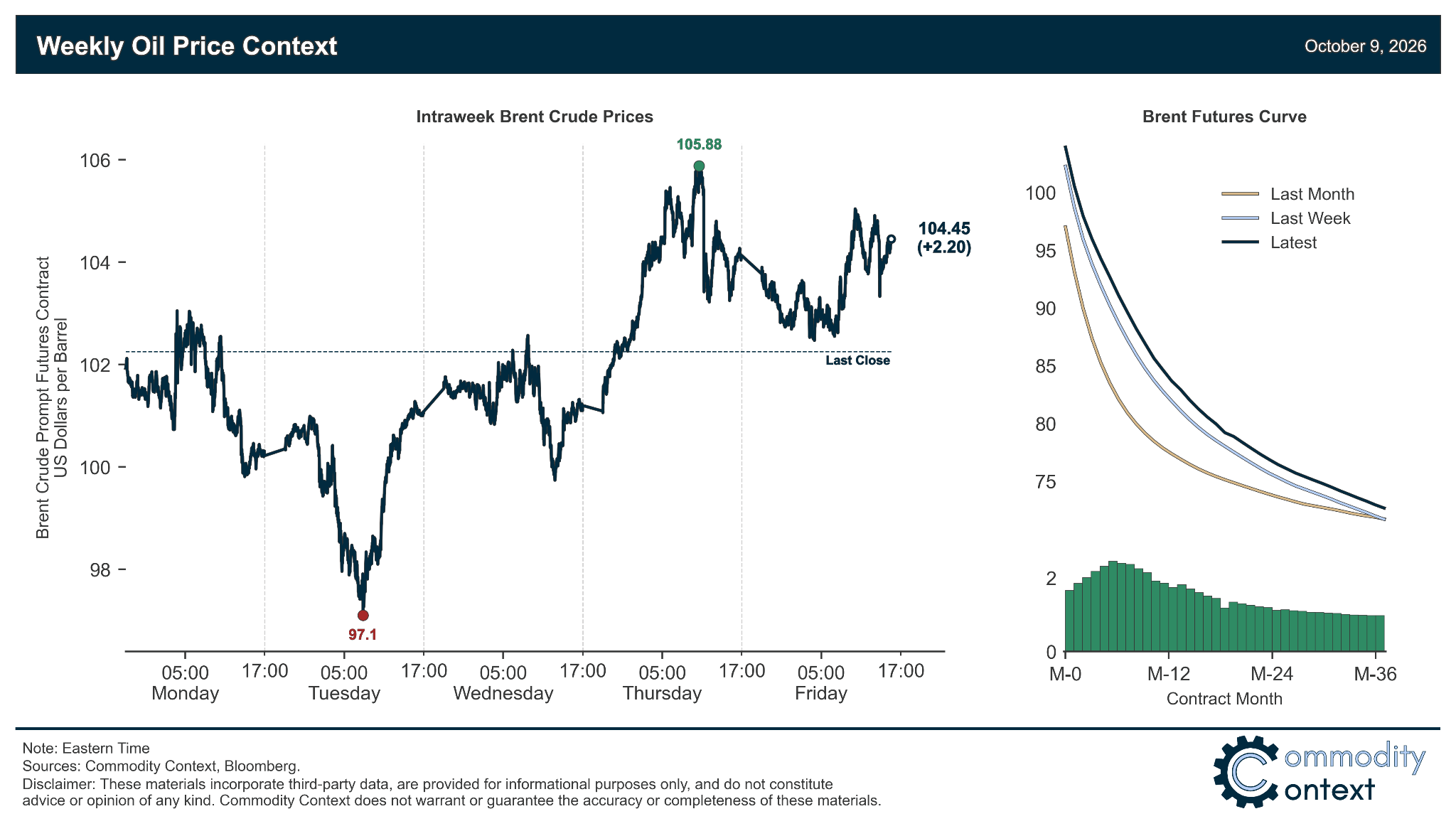
Summary
Flat Prices rose roughly $2/bbl for Brent to end above $104/bbl, though the small gain belies the nearly $10/bbl trading range during the week as the barrel was bounced between diplomatic hope, renewed talk of additional SPR action, rumours of pre-midterm election strikes, and then Trump’s explicit pledge (whatever that’s good for) to not attack before the midterms; all the while, the previously-improving pace of oil flow through the Strait of Hormuz slowed as shipping attacks escalated.
Timespreads remained firm but have begun to even more notably diverge between Brent and Dubai, both of which are still seeing very strong prompt backwardation, and WTI, which is now seeing prompt backwardation at the lowest level in two months; as with much of the dislocation in the current market, WTI’s relative weakness is largely due to skyrocketing tanker rates as well as some likely idiosyncratic US SPR-related weakening.
Inventories data was mixed as crude stocks began to decline again in the US alongside a very large pullback in ARA European crude stock that erased most of the recent building trend and brought levels back to the bottom of their trailing seasonal range.
Refined Products remain in largely uncharted territory, continuing to set fresh high seasonal levels; political pressure to find a solution to tight fuel supplies, especially for acutely-short diesel, has the White House flailing across all manner of desperate measures from expanding the allowable use of red dye diesel (normally only allowed to be used in off-road equipment) to, most recently, dropping sanctions on Russian diesel.
Market Positioning data revealed that speculators were modest net sellers of crude over the past week, but that small net movement was actually driven by more sizable declines of both long and short positions as hedge funds and other money management companies lost faith with directional oil market calls altogether.
As Well As oil flows slow through the Strait of Hormuz; it’s been all tit, no tat as Iran ramps shipping attacks; why and how did Iranian shipping attacks rise in the first place?; Trump announces new Russian diesel export pledge; and Chinese refined product exports are not out of the game.