

Happy Friday, Oil Watchers!
Every week, I summarize and analyze developments in flat crude prices, calendar spreads, high-frequency inventories, refined products, and positioning data, as well as a taste of the themes I’ve been thinking about or following closely—including our ongoing tracking of shipping flows throughout the Middle East.
Paid subscribers can access the latest weekly update of the detailed 40-page PDF Market Positioning Data Deck at the bottom of this report.
I’ll be in Washington, DC next week discussing our Beijing Swing research and sharing Hormuz Crisis thoughts with clients, other analysts, and policymakers. Drop me a line if you’re interested in grabbing a coffee or having me speak to your team. We’re also looking to put together a subscriber event while I’m in town; if you’re interested, please add your name to the form below the subscriber paywall.
In the latest episode of the Oil Ground Up podcast, I was joined by Michelle Brouhard, head of policy and geopolitical risk at Kpler, for a conversation focused on the world’s many spiralling geopolitical quagmires. We consider the options that global governments have to deal with the acute diesel supply crisis as well as the recent controversy surrounding tanker tracking data, which shows Hormuz transits rising notably over the past month, and whether Iran has “lost control” of the Strait.
For more free oil market context, check out my conversations with David Lin (YouTube), the Facts vs Feelings podcast (YouTube), the WTFinance podcast (YouTube), as well as BNN Bloomberg (YouTube) and The New Republic about the diesel crisis (Print)
If you’re already subscribed and/or appreciate the free chart and summary, hitting the LIKE button is one of the best ways to support my ongoing research.
Summary
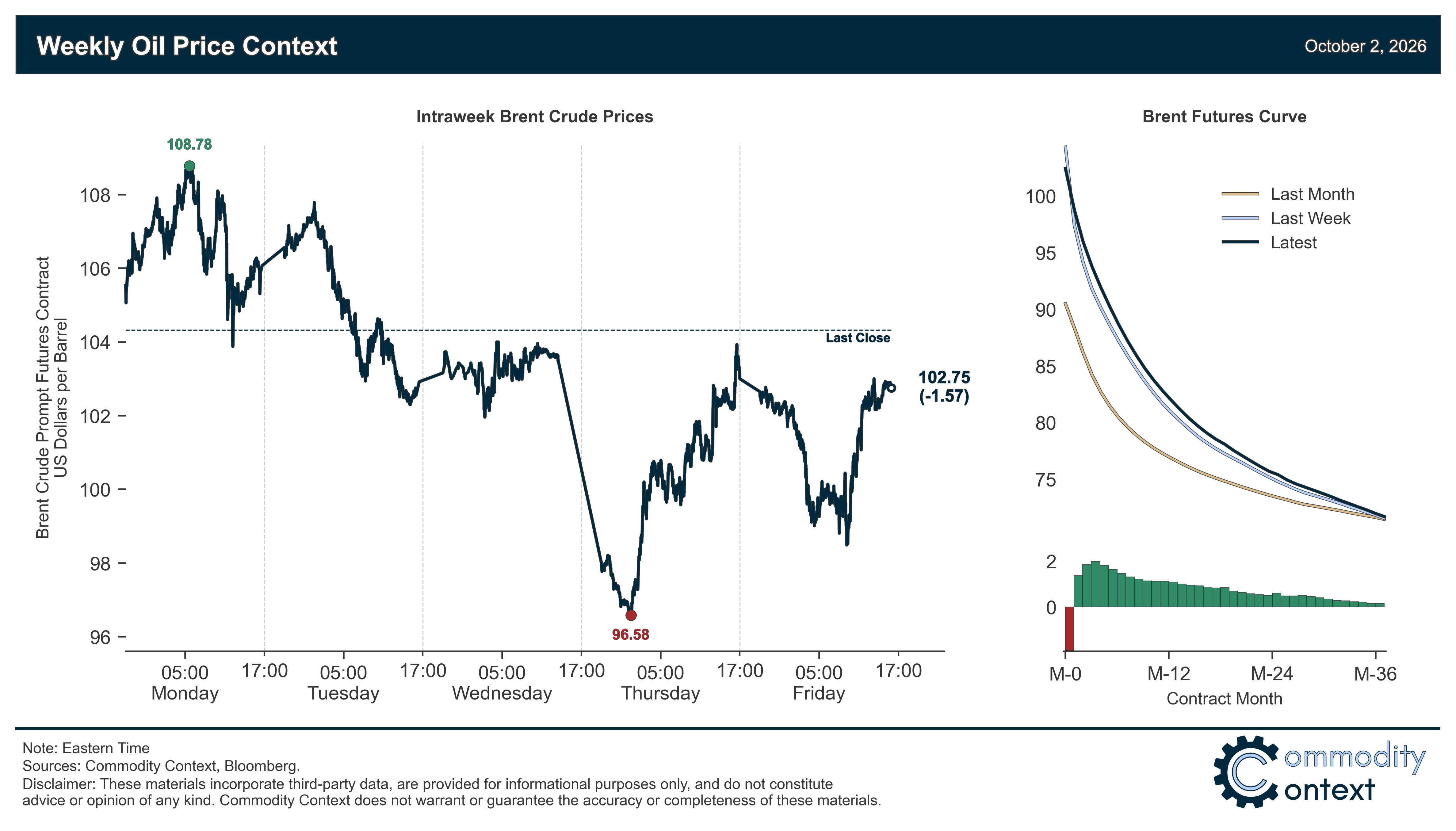
Flat Prices slipped ~$1.50/bbl but prompt Brent held over $100/bbl; while the recent recovery in Middle Eastern oil flows has calmed the market’s most frayed nerves, prices remain high and structure remains tight, indicating that prompt demand has rallied to meet any increased flows out of Hormuz.
Timespreads took a step back after their explosive performance last week, hitting a monthly high on Monday but otherwise steadily easing back into Brent’s November contract expiration on Wednesday; while front-curve timespreads have shed roughly half their backwardation relative to Monday highs, all curves continue to sport backwardation that would be, in any other moment, considered a sign of crisis-level prompt supply deficits.
Inventories saw product-heavy declines in the US and Singapore, while ARA European stocks rose from still-depressed overall levels.
Refined Products experienced extreme volatility as policy-driven headlines—from trade restrictions to SPR releases—buffeted precarious fuel markets; US diesel prices pulled to below a $90/bbl crack spread vs Brent, but only after hitting all-time intraday highs (~$125 crack, ~$228/bbl flat price) amid a contract expiry day squeeze.
Market Positioning data indicated that speculators were net sellers of crude futures and options contracts over the past week through Tuesday driven by a pullback in gross length; this is a relatively bullish print given a net pullback in speculative positioning while prices actually climbed ~$4-5/bbl—the far stronger pull of physical over paper market influences.
As Well As European nations announce diesel-heavy SPR release; East-West Pipeline flows are accelerating much faster than expected; Middle East flows data sparks debate and weighs on prices; and Our Middle East Flow Context (hint: a very probable pullback)