

Happy Friday, Oil Watchers!
Every week, I summarize and analyze developments in flat crude prices, calendar spreads, high-frequency inventories, refined products, and positioning data, as well as a taste of the themes I’ve been thinking about or following closely—including our ongoing tracking of shipping flows throughout the Middle East.
Paid subscribers can access the latest weekly update of the detailed 40-page PDF Market Positioning Data Deck at the bottom of this report.
For more public oil market context, check out my discussion with Contrarian Codex (audio), Mario Nawfal (video), and MacroHive (video), as well as my contributions to The New York Times (print) and Axios (print).
If you’re already subscribed and/or appreciate the free chart and summary, hitting the LIKE button is one of the best ways to support my ongoing research.
Summary
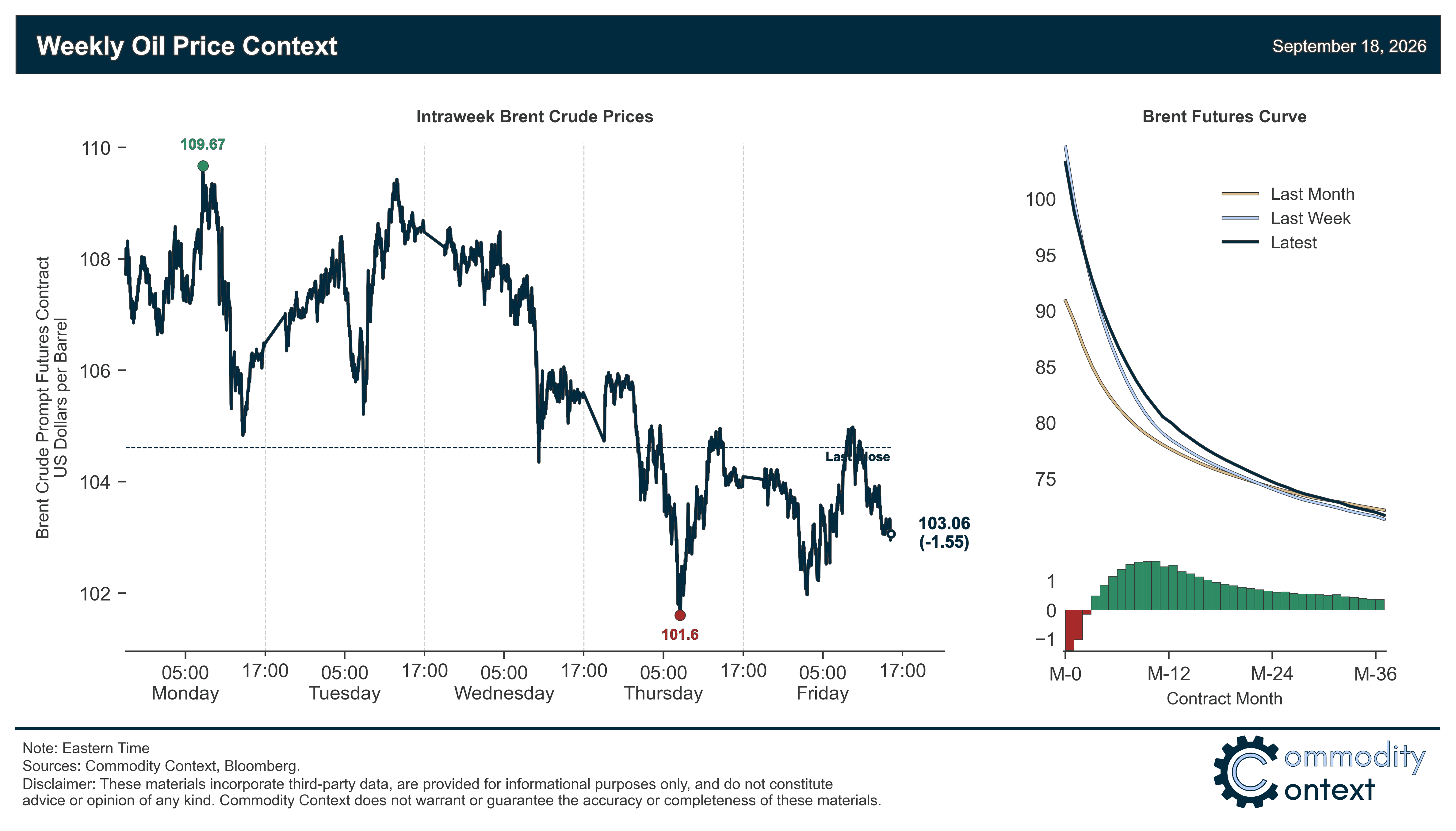
Flat Prices fell just more than $1/bbl for Brent crude to end the week around $103/bbl, still higher than before the East-West pipeline was taken offline by Iranian proxy attacks; Dated Brent hit a high of nearly $132/bbl before pulling back later in the week.
Timespreads were flat to weaker, though only from their immediate post-Saudi pipeline attack rally and still hold steeper prompt backwardation than before the attacks occurred; indeed, the trend toward steeper prompt backwardation has been building for the past 3 weeks and indicating a growing shortfall of prompt barrels relative to demand before this latest loss of physical supplies.
Inventories data leaned unanimously bearish thanks to moderate-to-large builds across all major tracked consuming regions; US stock builds are heavily product-tilted while a second considerable light distillate-driven build in Singapore brought overall stock levels back within the seasonal range after months of depressed holdings.
Refined Products markets continue to be dominated by crisis-scarce diesel supplies, which pushed the price of the industrial workhorse fuel to more than $220/bbl in New York Harbor (more than double the price of Brent crude); despite these sky-high diesel prices, prompt backwardation, while obviously steep, is still below both March-April and peak-2022 levels, indicating that markets are beginning to position for a longer-lived stretch of distillate shortages.
Market Positioning data confirmed that speculators were only modest net buyers of crude this week despite the roughly $10/bbl gain between the two sample periods, indicating that physical panic-buying rather than a surge in speculative paper flows drove crude prices higher following the attacks on the East-West pipeline.
As Well As Saudi East-West pipeline out of service, what this outage and the recently communicated repair timeline mean for oil market flows, and why wasn’t Saudi Arabia already more aggressively trying to get barrels out of Hormuz before this attack that forced their hand? Meanwhile, oil flows through the Strait of Hormuz continue to grind higher, and wealthy countries mull additional strategic petroleum reserve releases.