

Happy Friday, Oil Watchers!
Every week, I summarize and analyze developments in flat crude prices, calendar spreads, high-frequency inventories, refined products, and positioning data, as well as a taste of the themes I’ve been thinking about or following closely—including our ongoing tracking of shipping flows throughout the Middle East.
Paid subscribers can access the latest weekly update of the detailed 40-page PDF Market Positioning Data Deck at the bottom of this report.
If you’re already subscribed and/or appreciate the free chart and summary, hitting the LIKE button is one of the best ways to support my ongoing research.
Summary
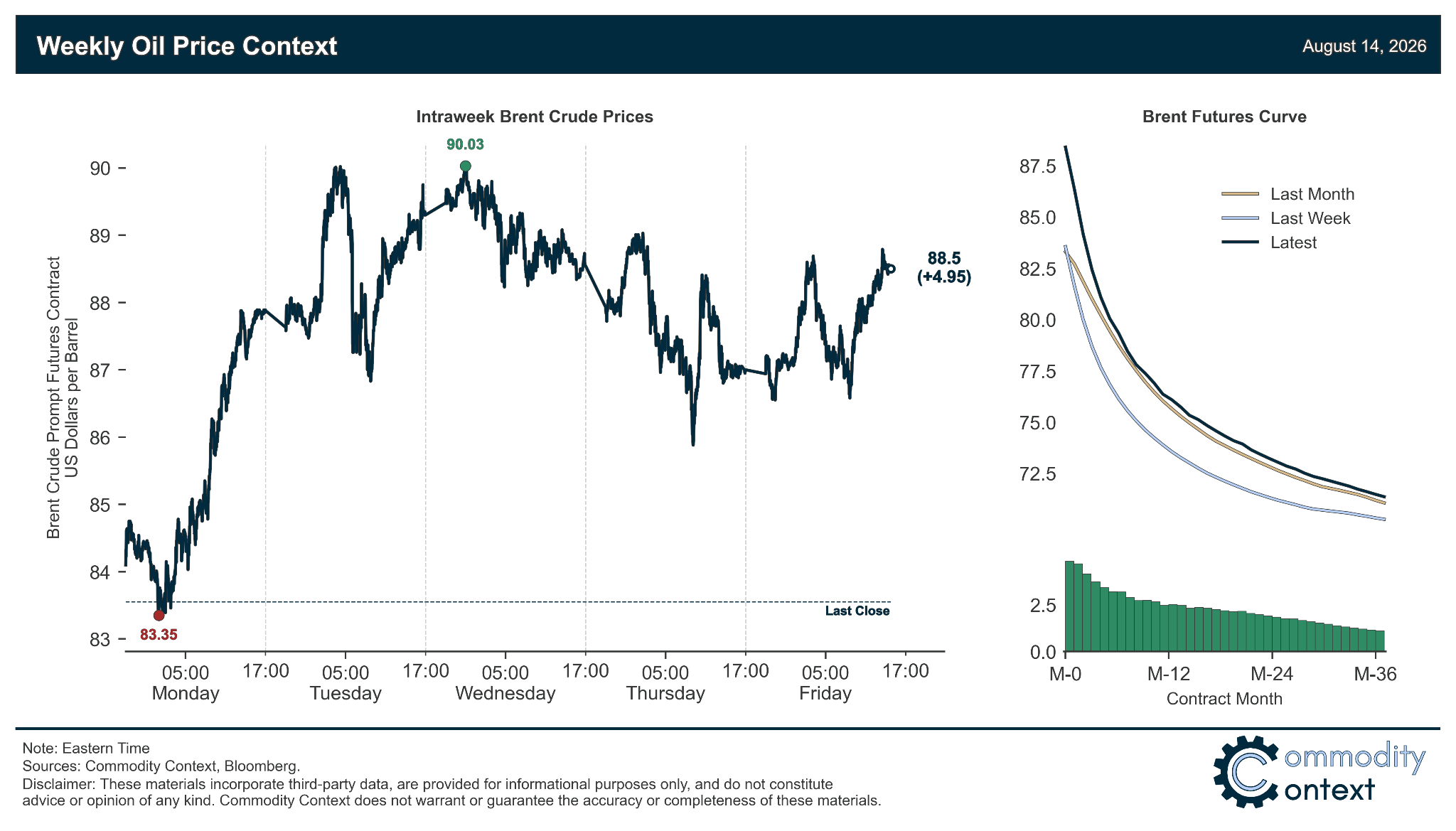
Flat Prices rose $5/bbl this week for Brent crude to finish just below $90/bbl amidst fading hopes of a Hormuz management deal and talk of a far longer conflict, with prices further benefitting from a surge of inbound hot money flow.
Timespreads were split, with prompt timespreads for Brent largely unchanged around $2/bbl, Dubai’s doubling to roughly $3/bbl, and WTI’s gradually easing to around $1/bbl; despite the cross-grade differences, all major benchmarks continue to signal notable supply tightness via elevated—at least by historical comparison—prompt backwardation.
Inventories data was mixed but dominated by the massive 17+ million barrel build in US commercial crude stocks, which was driven by an acute and abrupt swing in the US crude trade balance; that trade balance is shifting the global supply deficit from drawing on US crude stocks toward the rest of the world, that, until recently, the US had stepped in to supply.
Refined Products rallied again after last week’s pullback as US gasoline cracks gained $5/bbl and US diesel margins gained ~$10/bbl to above $90/bbl; stocks of key road fuels are low and refinery runs were roughly 5 MMbpd lower year-over-year in July.
Market Positioning data confirmed that speculators were, once again, sizable buyers of crude futures and options contracts, pushing up the net speculative position as a share of total open interest to its highest level since early June; high speculative positioning, with crude prices still only in the high-$80s, is a downside price risk given a growing volume of capricious positions that are likely to be liquidated en masse when momentum inevitably swings lower again.
As Well As the war that never ends, US Energy Secretary’s 9 million barrel Hormuz exit claim sparks renewed focus on Hormuz outflows, parallel crisis in the Red Sea deepens and Saudi crude loadings struggle, and US asks Ukraine to ease up on CPC terminal attacks.